Thursday, September 22, 2011
Bruce Lipton Thoughts = energy
Invest your thoughts wisely. If you consider your thoughts are like your cheque book, you wouldn't waste money, why waste your thoughts? Thoughts are a unit of energy. 25% of your body's energy feeds your brain. Listen and learn more about thought energy....


Tuesday, September 20, 2011
Construction1
 Construction begins. After months of planning.
 The teetering Chiropractic office!


Stay tuned for more updates, the fascinating process of improvement.
Thursday, September 15, 2011
Effects of Meditation on the Brain.
 From Dr. Terry Rondberg, DC
Now, there’s a follow-up study, which appears in the online edition of the journal NeuroImage,
suggesting that people who meditate also have stronger connections between brain regions and show less age-related brain atrophy. Having stronger connections influences the ability to rapidly relay electrical signals in the brain. Significantly, these effects are evident throughout the brain, not just in specific areas.
Eileen Luders, a visiting assistant professor at the UCLA Laboratory of Neuro Imaging, and colleagues (study co-authors Kristi Clark, Katherine L. Narr and Arthur W. Toga) used a type of brain imaging known as diffusion tensor imaging, or DTI, a fairly new imaging mode that supplies insights into the brain’s structural connectivity. They found that the differences between meditators and controls are not limited to a particular core region of the brain. They involve large-scale networks that include the frontal, temporal, parietal and occipital lobes, and the anterior corpus callosum, as well as limbic structures and the brain stem.
“Our results suggest that long-term meditators have white-matter fibers that are either more numerous, more dense or more insulated throughout the brain,” Prof. Luders said. “We also found that the normal age-related decline of white-matter tissue is considerably reduced in active meditation practitioners.”
The study consisted of 27 active meditation practitioners (average age 52) and 27 control subjects, who were matched by age and sex. The meditation and the control groups each consisted of 11 men and 16 women whose meditation practice spanned 5 to 46 years. Self-reported meditation styles included Shamatha, Vipassana, and Zazen, styles that were practiced by about 55% of the meditators, either exclusively or in combination with other styles.
Results showed distinct structural connectivity in meditators throughout the entire brain’s pathways. The greatest differences between the two groups were observed within the corticospinal tract (a collection of axons that travel between the cerebral cortex of the brain and the spinal cord), the superior longitudinal fasciculus (long bi-directional bundles of neurons connecting the front and the back of the cerebrum), and the uncinate fasciculus (white matter that connects parts of the limbic system, such as the hippocampus and amygdala, with the frontal cortex).
“It is possible that actively meditating, especially over a long period of time, can induce changes on a micro-anatomical level,” said Luders, herself a meditator.
As a consequence, she said, the strength of fiber connections in meditators may increase and possibly lead to the macroscopic effects seen by DTI.
“Meditation, however, might not only cause changes in brain anatomy by inducing growth but also by preventing reduction,” Luders noted. “That is, if practiced regularly and over years, meditation may slow down aging-related brain atrophy, perhaps by positively affecting the immune system.”
But – there’s a “but.” While it’s tempting to assume the differences between the two groups constitute actual meditation-induced effects, nature versus nurture remains the unanswered question.
“It’s possible that meditators might have brains that are fundamentally different to begin with,” Luders said. “For example, a particular brain anatomy may have drawn an individual to meditation or helped maintain an ongoing practice – meaning that the enhanced fiber connectivity in meditators constitutes a predisposition towards meditation, rather than being the consequence of the practice.”
Still, she said, “Meditation appears to be a powerful mental exercise with the potential to change the physical structure of the brain at large. Collecting evidence that active, frequent and regular meditation practices cause alterations of white-matter fiber tracts that are profound and sustainable may become relevant for patient populations suffering from axonal demyelination and white-matter atrophy.”
Luders said, however, that more research is needed before taking meditation into clinical trial studies.
SOURCES: “Enhanced brain connectivity in long-term meditation practitioners,” NeuroImage Volume 57, Issue 4, 15 August 2011. ABSTRACT
“Is meditation the push-up for the brain?” University of California, Los Angeles (UCLA), Health Sciences
Tuesday, August 16, 2011
"First Remove the Pressure!"

Sounds simple, but it's true. your foot WON'T heal until the offending pressure is removed first. and once the fcinder block is removed, don't expect your foot to look or feel great right away! IT's going to take time to repair all the carnagte. the same principle applies to your Chiropractic care.
A misaligned vertebrae (subluxation) acts like a cinder block on a nerve causing damage, pain and inflammation. healing can occur only when the offending pressure is removed and kept off the nerve with regular Chiropractic adjustments. But that won't necessarily bring instant relief. Removing the pressure is simply the first step in a timely process.
So if you don't feel great immediately after your adjustment, don't be discouraged. With time, damaged tissues will heal and you will feel like new again. For now, be confident the healing process has at least started because the cinder block has been removed.
Monday, August 15, 2011
What would your cows do?
Institute for Responsible Technology

The Institute for Responsible Technology is a world leader in educating policy makers and the public about genetically modified (GM) foods and crops. They investigate and report their risks and impact on health, environment, the economy, and agriculture, as well as the problems associated with current research, regulation, corporate practices, and reporting.
Tuesday, July 26, 2011
On the move.
 |
| Second Load. |

 |
| Add lights, paint and ACTION! |
 |
| Jesse |
 |
| Placing the heavy adjustment table. |
 |
| Must take care of our movers. |
 |
| Notice what Shaun is moving.... |
 |
Mobile adjusting, Chiropractic on the move.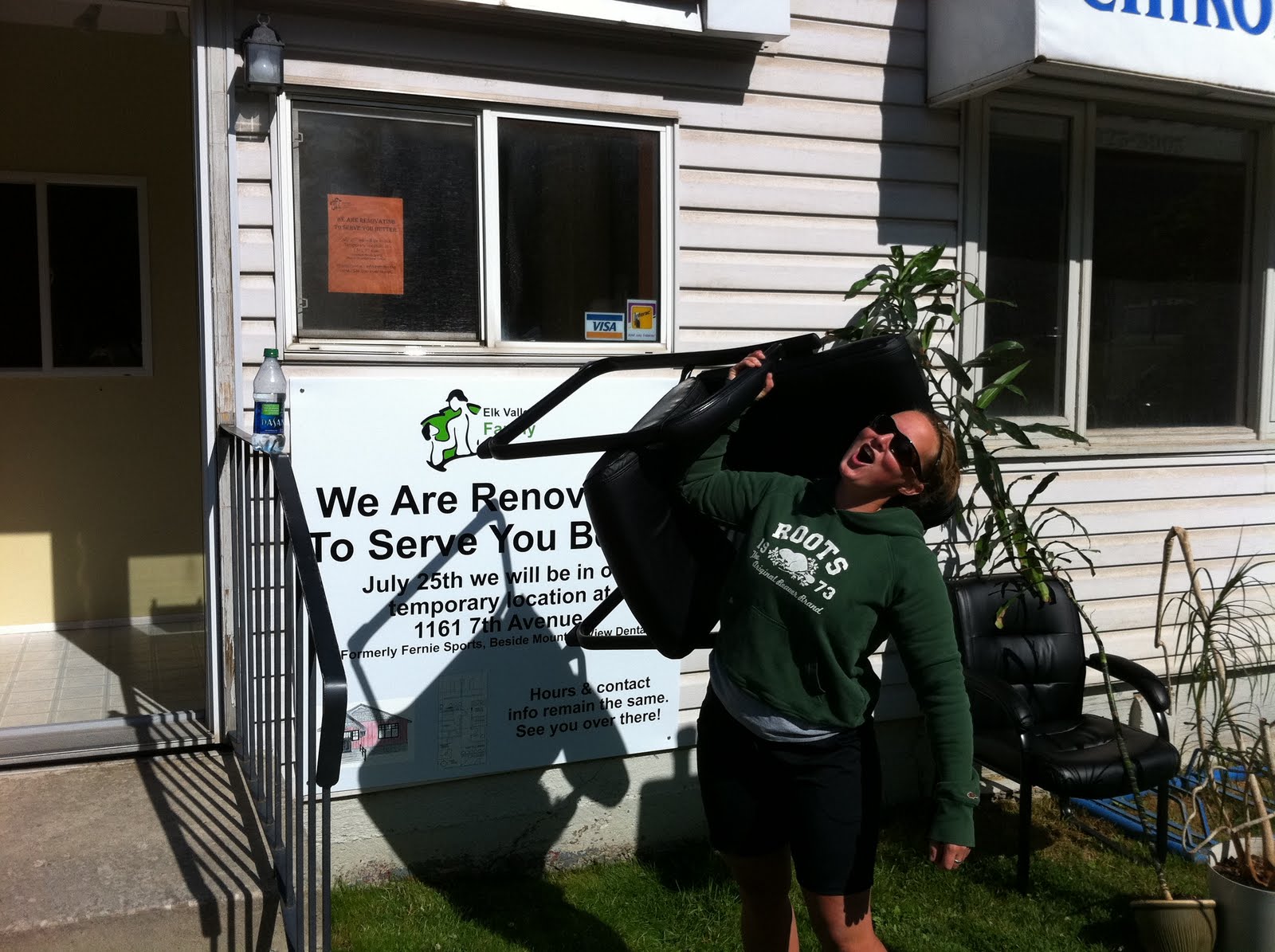 |
Monday, July 25, 2011
Team Work!
 |
| A small part of the team. |
 |
| The future Dr. Shaun, back to his roots painting. |
Wow! Team work in action this past weekend at the office! And what a team we had! Thanks to Tannis for Friday's run. Then Saturday was Cathy and a trailer, thank you. Thanks to Jason for the use of his Trailer. The movers that came on time, and were so enthusiastic! Thanks to Jason, David and Levi! What a crew. In no time we had the old office emptied. By 7 p.m. we were set up in the new space. It is amazing how focused everyone was, completing this project in record time and it looks fabulous! Support in this community has always been great. Thank goodness for Shaun, who also paints. He was so busy painting, we hardly saw him.
.
Mandy was an excellent packer, she seemed to get carried away at times, packing everything in sight. Although we didn't need to move the toilet, we came close to removing it for fun! |
| Boxed up and ready. |
Jamie at Elk Valley Networks was so helpful with computers. There are always glitches and Jamie just glides through the glitches. Expert help, so accommodating and encouraging. The front desk is command central and after packing all those cables and cords, we were glad we didn't have to reassemble them.

Drop by to see the new temporary space at 1161 7th Ave. Or Call for your next adjustment. Stay tuned for more on the moving weekend, we have more photos and treats!

!
Subscribe to:
Posts (Atom)